
March 18, 2026
The CASC Spring 2026 Member Meeting brought together members, distinguished guests and federal agency speakers and policymakers at American University’s Constitution Hall in Washington, DC on March 10–12 for three days of substantive discussion on the future of research computing, artificial intelligence, national science infrastructure, and federal policy. Speakers from the U.S. Department of Energy, the National Science Foundation, NIH, and partner organizations joined CASC members for sessions spanning everything from regional AI hubs and the Genesis Mission to data sharing compliance.
Tuesday, March 10
Reflections on the NSF-CASC Workshop: Envisioning NAIRR State and Regional Hubs for Educational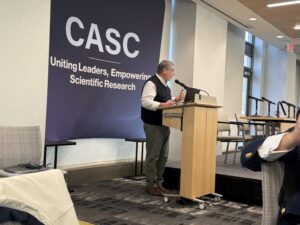 Transformation Joel Cutcher-Gershenfeld (Brandeis University) opened the meeting with reflections from the NSF-CASC workshop on envisioning statewide and multi-state regional NAIRR Hubs for Educational Transformation. A subsequent panel moderated by Barr von Oehsen (CASC Director of Membership, Elections and Outreach – Pittsburgh Supercomputing Center) brought together participants from across the country to discuss key workshop takeaways. Themes included the central importance of education —particularly how under-resourced campuses can be brought into the national AI ecosystem—and the risk of building regional silos rather than connected, collaborative networks. Panelists emphasized that progress on these challenges ultimately comes down to people: building human capacity and community alongside technical infrastructure.
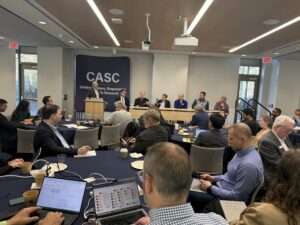 NSF Office of Advanced Cyberinfrastructure Update Katie Antypas, Director of NSF’s Office of Advanced Cyberinfrastructure, provided updates on OAC priorities and programs. Members were encouraged to share impact stories and to note NSF award connections clearly in their communications—concrete examples of outcomes help NSF demonstrate the value of its investments to Congress and other stakeholders.
What Are Institutions Doing as an AI Strategy? An afternoon panel moderated by Doug Jennewein (Arizona State University) brought together representatives from Georgia State University, Clemson University, and the University of Virginia to discuss how their institutions are approaching AI strategy. The conversation highlighted the range of approaches underway—from governance frameworks to infrastructure investments—and the common challenges institutions face as they try to act deliberately amid rapid change.
CASC Positions Workgroup: Business Model The Business Model Positions Committee Workgroup, moderated by Todd Shechter (University of Wisconsin-Madison), reported on its work examining sustainable models for research computing organizations. The CASC Mentoring Circle Framework was also introduced, reflecting the organization’s ongoing commitment to professional development for the research computing community.
Wednesday, March 11
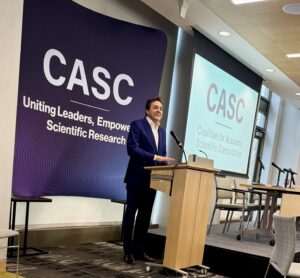 Genesis Mission Report — Dario Gil, Under Secretary for Science, U.S. Department of Energy Under Secretary Dario Gil delivered a keynote on the DOE’s Genesis Mission, describing it as a national effort to position the United States at the forefront of AI-driven science. He noted that universities currently lack sufficient AI supercomputing capacity and called for deeper partnerships with industry to address this gap. Two 10,000-GPU clusters are being deployed at Argonne National Laboratory and Oak Ridge National Laboratory—delivered at record speed through co-investment with AMD and cloud partners. A larger 100,000-GPU effort is underway at Argonne. Gil also previewed plans for quantum computers by 2028, noting that the U.S. spends roughly a trillion dollars annually on R&D across public and private sectors, and that coordination—not siloed efforts—is what will make the difference. He emphasized the importance of human capital alongside computing infrastructure, and asked the CASC community for its help in making the case to the White House and Congress. “This is the national effort asked by the President,” he said, urging collective action across agencies and institutions to push the power of computing to the center of the scientific enterprise.
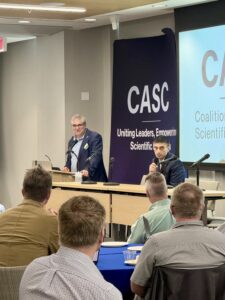 Enabling Agile, Locally Driven Coalitions for National Educational Transformation — Erwin Gianchandani, NSF Erwin Gianchandani, Assistant Director of NSF’s Directorate for Technology, Innovation and Partnerships (TIP), described the TIP ecosystem as a platform for creating new kinds of collaboration—across agencies, institutions, industry, and community colleges—that can drive educational transformation at national scale. He highlighted the NAIRR as a workforce development vehicle as much as a research infrastructure, and pointed to SBIR programs and NSF TIP’s portfolio of more than 2,000 startups, which have collectively attracted over $32 billion in venture and angel investment, as evidence of the ecosystem’s potential. On quantum computing, Gianchandani offered a candid assessment: quantum is roughly where AI was a few years ago—significant progress, but not yet realized in a transformative way. NSF is working to bring users and industry partners into quantum research more deliberately to accelerate the connection between fundamental science and practical application, including through a dedicated quantum program at the Cleveland Clinic. He also previewed NSF Tech Accelerators, which are set to roll out soon, as a new mechanism to move promising platform technologies from research into commercial application.
Expanding the Research Computing Ecosystem: Collaboration Pathways with AIHEC, MS-CC & Community Colleges A panel moderated by Jill Gemmill (Vice Chair, Clemson University) explored how CASC members can build meaningful pathways with Historically Black Colleges and Universities, tribal colleges, and community colleges to expand the research computing ecosystem. Panelists from San Jacinto College, Fisk University, Lorain County Community College, and Oglala Lakota College shared their institutions’ perspectives and needs, and discussed how collaboration with R1 universities and national computing centers can broaden access and opportunity.
CASC Positions Workgroup: RCD Resource Collaboration Model Katia Bulekova (Boston University) moderated a session presenting the CASC Positions Workgroup’s work on a Research Computing and Data (RCD) Resource Collaboration Model—a framework for how institutions can share resources, expertise, and infrastructure to collectively expand capacity without duplicating effort.
ASAP: “American Science Cloud” Max Katz, Policy Advisor from Senator Martin Heinrich’s office, presented on the American Science Acceleration Program (ASAP) and the concept of an “American Science Cloud”—a vision for federally coordinated cloud and computing infrastructure to support the scientific research enterprise at scale.
Thursday, March 12
Leveraging AI Enhancements to Accelerate Scientific Productivity — Hal Finkel, DOE Hal Finkel, Division Director for DOE Computational Science Research and Partnerships, outlined the Department’s work at the intersection of AI and scientific discovery. DOE is building the largest repository of federated scientific data and developing next-generation language and reasoning models, as well as new models focused on materials science, energy, and surface science. Surrogate models are already being deployed to support national security grand challenges, and DOE has identified 26 grand challenges—spanning areas such as scaling the grid, particle accelerators, AI-driven autonomous laboratories, and quantum algorithm discovery—that its portfolio will address. A funding announcement for this portfolio is expected soon. The Genesis Mission Consortium, launched on February 9, brings together national labs and industry partners to co-invest in this work.
NIH Policies and RFIs on Data Sharing, Research Security, and Evolving Compliance Expectations — Taunton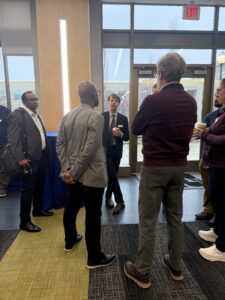 Paine, NIH Taunton Paine, Director of NIH’s Scientific Data Sharing Policy Division, walked through the current landscape of NIH data sharing policy and recent regulatory developments. NIH’s two major data sharing frameworks—the 2014 Genomic Data Sharing Policy and the 2020 NIH Data Management and Sharing Policy—form the foundation for how NIH supports public trust in research data, including through more than 40 controlled-access repositories for human data. Recent legislative and executive actions have added new compliance requirements, including restrictions under the Consolidated Appropriations Act of 2023, a 2024 Executive Order on limiting access to sensitive personal data by countries of concern, and a 2025 DOJ rule restricting data transactions with six designated countries. NIH has updated its Controlled Access Framework in response and released an RFI on proposed revisions to the Genomic Data Sharing Policy. Paine stressed the importance of identity proofing, transparency, and adherence to NIST SP 800-171 standards for approved users of controlled-access genomic data.
CNI Update — Kate Zwaard, Coalition for Networked Information Kate Zwaard, Executive Director of the Coalition for Networked Information, presented CNI’s current horizon-scanning priorities, which include research data infrastructure and stewardship, AI governance, cybersecurity, and workforce and expertise development. Zwaard noted that centralized IT intentions are in flux at many institutions, and invited dialogue with CASC on what the research computing community sees as the most pressing emerging issues—framing it as an opportunity for the two organizations to align and amplify their work.
Key Themes from Spring 2026
- National AI infrastructure requires unity and coordination. Speakers from DOE, NSF, and Congress converged on a message: the U.S. needs to act collectively—across agencies, institutions, and industry—to build the computing infrastructure that science and national competitiveness demand.
- Educational institutions must be built into the infrastructure from the start. Multiple sessions emphasized the importance of bringing under-resourced institutions—community colleges, HBCUs, tribal colleges—into the national research computing ecosystem, not as an afterthought but as a design principle.
- The policy environment is consequential and moving fast. From NIH data sharing compliance and restrictions on data access to congressional proposals for an American Science Cloud, the regulatory and legislative context for research computing is evolving rapidly. CASC members have a role to play in shaping these policies.
- Quantum computing is the next horizon. Multiple speakers pointed to quantum as a field approaching an inflection point, with significant new investments from both DOE and NSF expected in the coming years.
- Human capital is as important as hardware. Across sessions, speakers returned to the theme that infrastructure alone is not enough—workforce development, mentoring, and broadening participation are essential to realizing the potential of the national research computing enterprise.
CASC thanks all members, speakers, and guests for making Spring 2026 a rich and productive gathering. We look forward to continuing these conversations at our next meeting.