
ARLINGTON, Va., October 22, 2026 — Leaders of university and national laboratory computing centers met October 20-22 at George Mason University for the Fall 2026 meeting of the Coalition for Academic Scientific Computation (CASC). Discussion centered on artificial intelligence, quantum computing, and a federal funding picture that increasingly favors regional partnerships.
CASC represents about 113 higher education organizations and labs that provide the supercomputers, data systems, and expertise behind academic research.
Building partnerships that last
The week opened with a record 135 attendees at the CI Leadership Academy, a workshop on building regional and state computing consortia. Participants concluded that successful partnerships start with understanding what state governments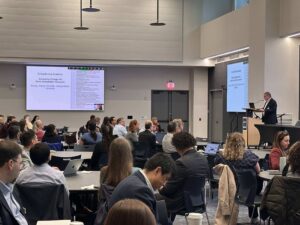 and campus leaders care about, and that RCD leaders from all institutional types should help shape these efforts from the beginning. Speakers from philanthropy and industry noted that funders are looking for large-scale projects and long-term plans rather than one-off requests.
Federal programs take shape
Officials from the Department of Energy described its Genesis Mission as moving from concept to working platform, with new ways for universities to participate. The agency’s first funding call drew more than 5,000 applications and resulted in 278 awards involving 342 institutions. The Department also announced a quantum computing initiative that includes a competition to demonstrate fault-tolerant quantum systems by 2028.
The National Science Foundation announced six awards totaling $83 million to expand national data infrastructure for AI-driven research. The agency also said a new national AI research operations center, backed by a five-year, $35 million agreement, began work October 1 and aims to serve up to one million students. A preliminary online portal is targeted for January 2027.
The global research race
Speakers also placed the work in a broader context. Data from the National Science Board show that China passed the United States in total research and development spending in 2024, and both countries topped $1 trillion for the first time. A Department of War adviser said computing underpins AI, quantum, materials, and cyber capabilities in a long-term strategic competition. A Washington policy briefing noted that Congress has funded agencies through December 11 at mostly last year’s levels, with full-year budgets still unresolved.
Preparing the next generation
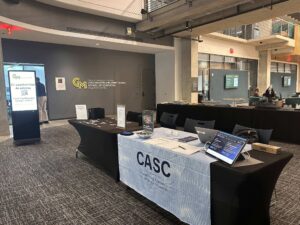 Members compared notes on how campuses are governing AI and how research computing teams can prepare for quantum technology. Eight emerging leaders from the Midwest Research Computing and Data Consortium presented four practical toolkits, including a guide for new managers and a resource for introducing high school students to supercomputing.
What’s next
CASC will gather again at the SC26 supercomputing conference in Chicago in November, at Georgetown University in March 2027, and at PEARC27 in Raleigh, North Carolina, July 11-15, 2027.
Media contact: Kathryn Kelley, Executive Director, CASC, kelley@casc.org, 202.670.5798.